
Credit: Drone JP
With the news of an expected £3 million to be spent on improving leisure centres across the borough of Bolton, it got me thinking. Have we reached a turning point for buildings that have been slowly falling out of use for decades?
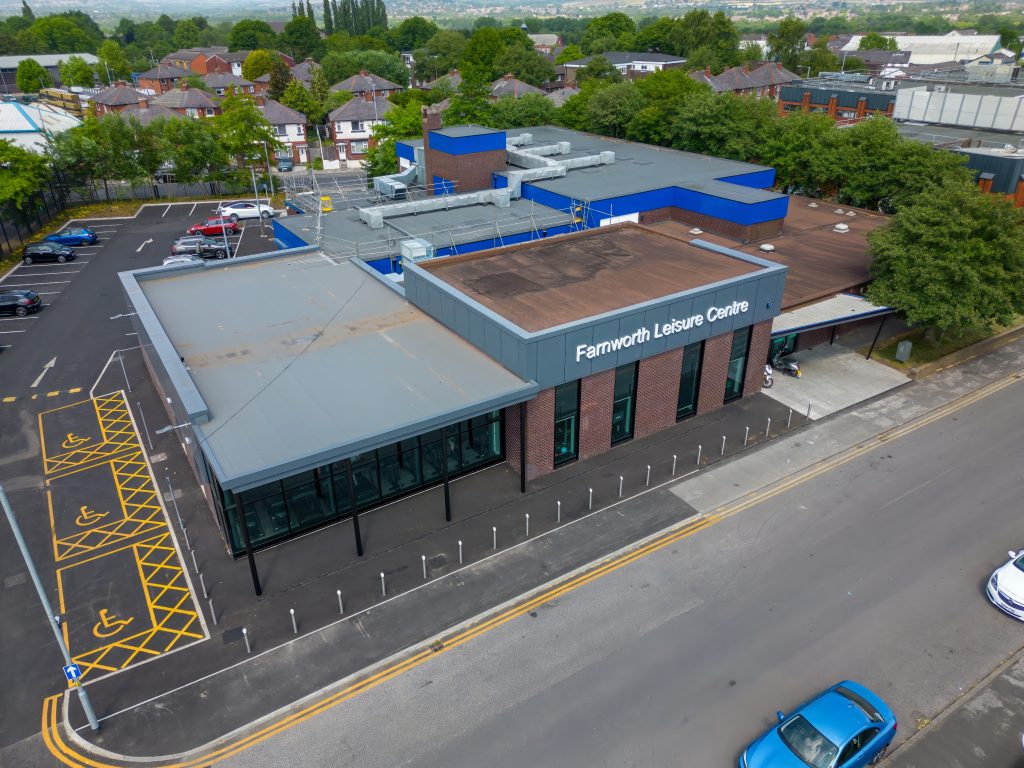
K2 recently completed the extension of Farnworth Leisure Centre in 2023, providing space for a broader range of facilities, primarily an enlarged fitness suite, alongside a new studio space for dance and yoga. The extension has given the 1970s building a much-needed update, introducing facilities that better reflect current use.
The extension has been successful, but it only tells part of the story.
Much of the original building remains unchanged. Systems, structures, and spaces designed over 40 years ago are still in place. The intervention improved the offer, but it didn’t fully resolve the underlying condition of the building.
This isn’t unique to Farnworth; it reflects a wider countrywide pattern.
In the 1970’s, leisure centres were a revolutionary concept, and the industry was expanding rapidly. They provided family-friendly, multi-purpose hubs for swimming, fitness and socialising. The priority was leisure over sport, with the facilities centred on fun and community, providing civic destinations.
Many of these buildings are now ageing. Maintenance costs have increased. Infrastructure is dated. Some have closed, others have been replaced, and many continue to operate in a reduced capacity.
Private gyms have reshaped expectations; more flexible, more immediate and often a more tailored experience. At the same time, rising energy costs have made large, publicly run facilities harder to sustain. However, there has been a shift in the opposite direction in more recent times.
Since the COVID pandemic, the rise in popularity of health & fitness has been significant. The birth of the fitness “influencer” has breathed new life into the industry, with many people talking about their next HYROX event, or whether you saw the half-marathon they completed at the weekend (I may be one of these people). Fitness has become more visible, more shared.
With the birth of the run club, the cross-training group classes at 6 am, and the group bike ride to the coffee shop you’ve always wanted to try. It’s arguably community and social events, rather than fitness and sport, which people crave.
The rising cost of private gyms has made public facilities more relevant again. There is an opportunity for leisure centres to re-establish themselves, not by directly competing, but by offering something more accessible based around routine and community use.
With the leisure centre being created on a pillar of community, this is the opportunity, but it requires investment.
Without funding, these buildings struggle to meet modern-day standards. They need to perform better, feel current and support the flexible use of a community. This funding in Bolton is a step in the right direction, suggesting a shift away from replacement towards reinvestment.