Town Halls lie at the heart of a network of community spaces vital for the social cohesion of our urban centres. Yet the civil service’s transition to hybrid working has left many redundant. Bolton Council tasked us with helping to determine a future for one of these much-loved buildings and keep it relevant to its community.
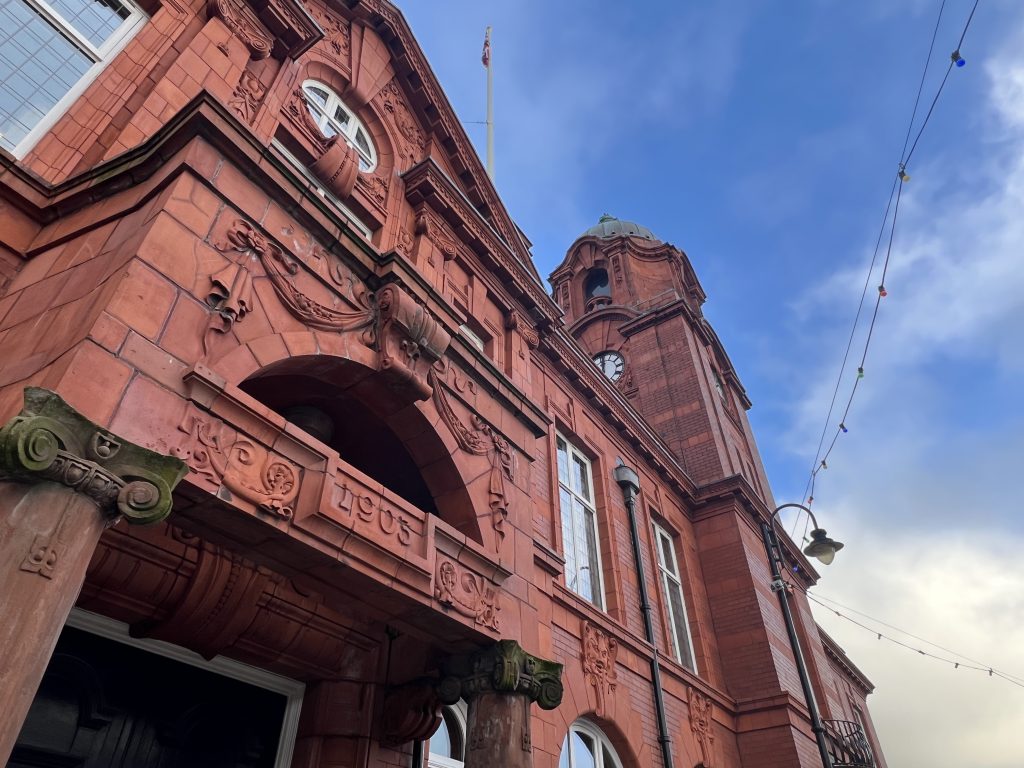
Westhoughton Town Hall is typical of the small local Town Halls that sprung up all over the country at the end of the Victorian era in response to the creation of District Councils. Today, as emblems of civic pride and identity, they hold powerful social and emotional bonds with the communities they serve.
It is to their credit that today’s larger local authorities have kept them operating for the benefit of their communities. However, the switch to hybrid working models and deep cuts to public service has changed all that, and the time has come for a radical rethink of their purpose.
Countless Town Halls like Westhoughton’s are ready for immediate sale or let. Yet, their footprints need to be more substantial to attract serious investment, and their complicated prescriptive layouts, elaborate decorations and expensive maintenance costs deter the smaller investor.
You also need to consider this type of building’s vital role in a town’s psychogeography. Communities disenfranchised by the seemingly relentless erosion of local services and infrastructure can quickly mobilise against any move to privatise their public assets.
Public and private sector deals that collide with local politics only reach satisfactory outcomes if everyone can agree on a negotiated compromise.
Architects working upstream in the strategic phase of a project must have the skills to navigate this tripartite dynamic with design solutions that demonstrate empathy and understanding.
The Challenge for Westhoughton Town Hall
Westhoughton was once a centre for Northern English coal mining, cotton spinning and textile manufacture that declined in the 1970s, evolving into a residential town close to Bolton, Wigan, and Manchester. Yet despite the last mill closing half a century ago, a walk around the town centre reveals evidence of deep respect and pride for its industrial heritage.
The Council shifted to a hybrid working model during covid, making the Town Hall redundant for its needs, save for the two-hour council meetings held fortnightly within its chambers. The sensitivity of the challenge presents the Project Team with several dilemmas. How can we?
- Protect the Council Chamber’s identity and culture.
- Act in the best interest of the local taxpayer by developing ethical public/private partnerships that fill the viability gaps in public spending.
- Protect and enhance the local community’s social infrastructure.
The role of Architecture in Leading Change
Change is a team effort. Enlightened clients know they must build a team of skilled experts in their field, project managers, business case writers, property agents, cost consultants and architects who align with their vision and values.
Executing bold and well-balanced strategies requires teams with a sense of self-awareness, modesty, and an understanding that their role links into a more extensive web of influences that they must address and balance against the project’s aims. Yet they must also possess the solid and decisive powers of thinking and leadership that give the project the freedom to evolve.
During this early phase of creativity, they must be able to take a laissez-faire approach, applying process and procedure with the scope and flexibility to allow the project to develop organically, gradually revealing the answers through a consultative process.
Within this dynamic, Architects hold a unique and vital role because they are humanists, bringing balance by representing society’s culture and needs—their creative skills bind together a project’s real and imagined objectives, making them the custodians of the project’s qualitative and the quantitative outcomes.
Architecture and Opportunity
Repurposing existing buildings is always a delicate balancing act. On the one hand, there is the requirement to respond to the owner’s strategic and operational needs. On the other, is obtaining the best fit for those needs in a building designed for different uses. In this scenario, we also need to preserve the features of the building that the community value. This tripartite challenge leans heavily towards an opportunity to drive market interest through the value of the building’s unique character.
To understand this sense of character, we begin with a detailed SWOT analysis that reverse-engineers the building’s design and uncovers its architectural DNA.
The original building, completed in 1904 and designed in the Mannerist Style, exerts a dominating civic presence over the town centre. In 1992 it was extended and refurbished in a manner and style that remains faithful to the original.
Externally, the building’s design emphasises symmetry, proportion, geometry, and regularity of parts inspired by classical antiquity, a style that presented itself to Edwardian Westhoughton as a metaphor for local leadership; simple, straightforward, orderly and in control. But it also kept the machinery of government behind closed doors, and the façade offers little clue as to what goes on inside. Modern enterprises, such as retail or office spaces, require building facades to provide more transparent frontages animated with internal activities describing the building’s purpose. If such an approach is deemed necessary, the architect must address this challenge with a degree of sensitivity to the architectural language.

Internally the original Town Hall design provided a mix of memorable and inspiring high vaulted, naturally lit public and private spaces replete with Doric columns, decorative panelling, and marble floors. There is much benefit to preserving the essence of these spaces, and their unique value offers the team a degree of focus and clarity as to their repurposing potential. By comparison, the rooms created in 1992 are much simpler and ready for comprehensive modernisation.
Strategic Design Considerations
As we begin the feasibility stage and consider our design options, the team must bear in mind the challenges and opportunities presented by the building.
- In refurbishment projects such as this, the building’s unique character and style are the values that drive market interest.
- Promote enhanced value through an economy of means and a sparing and restrained approach to design interventions.
- The varying scale and complex arrangements of the original ground floor spaces and the need for more active street frontage are not suitable for traditional high-street retailers. Therefore, consideration of more innovative uses is desirable.
- An adaptable loose-fit approach will preserve the building’s charm and character.
- We must protect the building’s ceremonial role in respect of its council chamber functions.
- Carving up the ground floor into individual units will present accessibility issues for people with disabilities. A single-use solution for the ground floor is more desirable.
- Activate the building’s façade with solutions sensitive to the original architectural language.
Fundamentally we must ensure that the project represents a balanced and considered design response to the commercial realities of public/private sector enterprise. We must also keep sight of the building’s social value. That is not to say we should be obliged to respect the existing relationship between town and people; instead, we should aim to enhance it.
Next Steps
In the next post, we will conclude the strategic design phase with an exploration of the design options that we considered.