
Flag Lane Baths in Crewe has been a focal point of the community since its opening 1937, as noted in its listing on the Cheshire Historic Environment Record. The fact that it was closed by Cheshire East Council in 2016 hasn’t changed this reality. Even though it was stripped of its civic function, the building still stands, like a huge, grounded Art Deco cruise liner washed up on the edge of Valley Park.
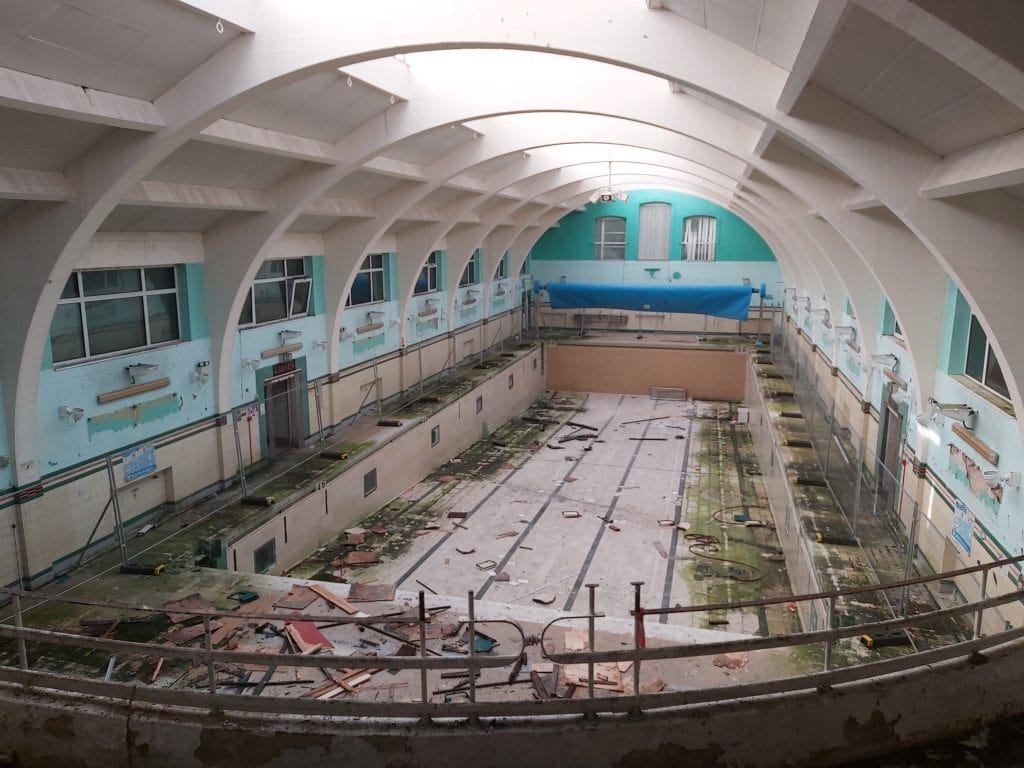
Though positive memories of Flag Lane Baths held by generations – the place where you went to bathe and wash, where you learnt to swim, are fading. New memories form with negative association – long abandoned, it is now the place to avoid for fear of anti-social behaviour; the graffitied eyesore to where the police keeping getting called. Or it’s the place to go because you’ve been told not to – the boarded-up windows and doors are the challenge for the urban explorer to beat – another conquest to capture and post online. Many young people will have no memory of when it was open.

It has become a grisly monument to the paralysis that can take hold when a local authority’s planning department regard a building as a significant historic asset through a local listing, while their asset management team come to view it as a liability – in the austerity squeeze of local authority funding, deemed too costly to run and maintain. Its functions have been moved to a new building across town, lessening the burden on local budgets, but the shell remains, gradually decaying while waiting for a viable new use considered suitably sympathetic to its heritage.
However, efforts to protect legacy can have unintended consequences – what is meant to preserve can become an obstacle to viability, baking in the decay. A decade of vandalism and the absence of the routine maintenance and upkeep that any building needs have taken a heavy toll. At what point does the deterioration of the building become so severe, and the costs to bring the building back into any kind of use become so prohibitive that the notion of conservation loses relevance, and the spectre of demolition becomes the most economically inevitable option? When is the tipping point reached where it is no longer an old swimming pool, but a ruin?
Today the building stands as a reminder of the financial investment in social infrastructure that was made in the community 90 years ago, but in the 2010s and 2020s seems out of reach. It is incumbent on local authorities to work constructively with partners, and to adopt a collaborative approach to overcome political hurdles that may currently be blocking deliverable and sustainable futures for such assets. A pragmatic balance needs to be struck with what is achievable in relation to economic repair and upgrading buildings to modern standards while being respectful of their heritage.
Buildings of such significance don’t just disappear from the collective memory of a town because someone locks the door. Flag Lane Baths needs a good news story, fast, and deserves to be given the opportunity to once more be the setting for positive memories for a new generation of the community.